


How Much Does That iPhone X Really Cost?
Warning Order
The iPhone X recently arrived on shelves at Apple stores and mobile carriers everywhere with a host of new features. All these new features come at a high price, $999 to be exact, as Apple sets the price bar ever higher to maximize their greatest source of profit. Even though most service members likely consider the smartphone a necessity, it is definitely a luxury good, particularly the iPhone X. In this article, I examine the long-term cost of the iPhone X's high purchase price and offer some tips on how to reduce smartphone expenses.
Situation
The iPhone X recently arrived on shelves at Apple stores and mobile carriers everywhere with a host of new features. The phone will likely be one of the hottest items going into the holiday shopping season and many shoppers may be eyeing it as an expensive stocking stuffer for themselves or their family. The new features include some of the standard upgrades like a larger display, better cameras, more processing power, and longer battery life. But the phone also has some newly introduced features, too! These include wireless charging, facial recognition, an edge-to-edge screen, and a glass cover. Personally, I really like the wireless charging, but the other features are not as interesting.
All these new features come at a high price, $999 to be exact, as Apple sets the price bar ever higher to maximize their greatest source of profit. In this age, most Americans and nearly all military service members have smartphones. Many run their lives through these phones. Additionally, the near ubiquity allows leaders at all levels to share information and adjust plans at a moment’s notice, for better or worse. Despite reaching this new price level, many experts predict exceptional sales of the iPhone X, but how much is that phone really going to cost in the long run?
Coordinating Instructions
Even though most service members likely consider the smartphone a necessity, it is definitely a luxury good, particularly the iPhone X. With limited funds to spend on housing, essential consumer staples, transportation, and other activities (including saving for financial goals), each choice presents what economists call "opportunity cost." Simply defined, an opportunity cost is a foregone benefit of spending money on something. $999 on an iPhone X is money that can't be spent fixing a car, can't be put toward a down payment on a house, and can't be invested toward retirement.
An iPhone X's True Cost
Let's look at a scenario showing the opportunity cost of purchasing an iPhone versus making a TSP or IRA deposit. For the scenario, we will assume Roth contributions (no tax deduction for contributions and no taxes upon withdrawal) and returns are after any fees.
Note: This chart is for illustrative purposes only. These hypothetical examples do not reflect a specific investment. Past performance does not guarantee future results.
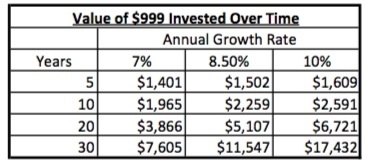
I included a range of possible returns and timeframes to allow comparison of different possibilities. A younger individual purchasing an iPhone X could be giving up $11,547 in their retirement account 30 years from now. While 30 years is a long-time, properly delayed gratification is crucial to making headway toward financial goals. And I'm not even accounting for the impending obsolescence of the iPhone X. Given one or two-year product release cycles, most purchasers of this iPhone will upgrade within two years, forking out another $1,000 or more if price trends continue. If the $11, 547 future price tag doesn't sway you, imagine making that same choice every two years until the concept of a smartphone is obsolete. Now we are talking huge amounts of money.
Options to Reduce the Impact of Smart Phone Upgrades
I'll admit the analysis in the previous section is on the extreme end of possibilities. First off, since most people rely on smartphones, the tradeoff is not as significant if we accept that phone upgrades on a regular basis. The true variable is how much they pay each time they upgrade. Here are a few options to defray the upgrade cost.
- Purchase a Brand New Older Model
Apple and other smartphone makers continue to sell older models for a period of time after releasing the latest model. For example, the iPhone 6 SE, which I still have, can be purchased directly from Apple for $349. It may not be as flashy as the iPhone X, but it definitely gets the job done. The iPhone 7 is available for $549. An even better deal is to buy a refurbished older model, saving even more.
- Keep Your Current Phone in Good Condition and Trade It In
If your current smartphone is in acceptable condition, you may be able to get decent trade-in credit from a mobile carrier or manufacturer. Deals vary, so shop around. Apple offers a $325 credit for the iPhone 7. Amazon will also buy older electronics, and you don't even have to make a purchase.
- Keep Your Current Phone for One More Year
Easier said than done, of course. But if your phone meets your needs and is working well, why be in a hurry to upgrade?
Command and Signal
The concepts in this post apply to nearly all discretionary purchases, not just smartphones. The iPhone X, even with its new features, pushes the limits on the cost for a smartphone. Astute shoppers and those who value their money will look for ways to cut the cost of upgrading their phones. Most of the options, such as purchasing an older model and trading in a current phone, can be combined to keep the cost to a minimum. For me, I'm just going to stick with my Phone 6 SE and keep my upgrade cost at $0 for now.